Traditional class handicapping relies on a dangerous assumption: that every race carrying the same official condition label requires the same ability to win. On paper, two Class 3 1200-meter turf handicaps at Sha Tin Racecourse, two 2-Win Class miles at Tokyo Racecourse, or two Class 3 sand sprints at Seoul Racecourse look identical. In reality, because race entries fluctuate by division splits, seasonal scheduling, and rating band clustering, one division can assemble a cutthroat field of rising stakes contenders while the very next race at the exact same class level draws an aging, out-of-form group running seven points below normal class standards.
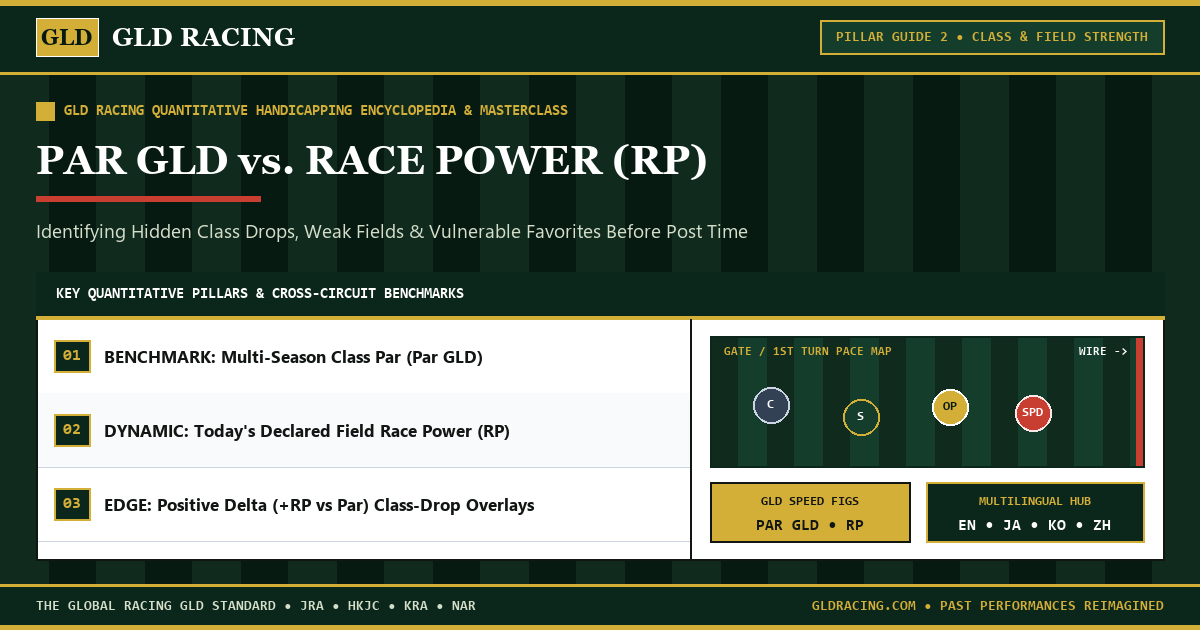
To exploit this discrepancy, GLD Racing equips handicappers with two complementary class metrics on every racecard header and past performance line: Par GLD (Empirical Class Par) and Race Power (RP). Mastering the gap between static Par GLD and dynamic Race Power is the single sharpest way to isolate hidden lateral class drops and fade over-bet newly promoted favorites across Japan, Hong Kong, and South Korea.
1. Defining Par GLD (GLD Class Par) vs. Dynamic Race Power (RP)
Before analyzing class movements, it is essential to distinguish what each number measures in the GLD Racing ecosystem:
- Par GLD (Static Empirical Class Benchmark): Derived from 865,435 historical starts in our
GLD Class Parbenchmark dataset (view the complete tables on `/stats/class-pars`), Par GLD represents the historical GLD Speed Figure required to win a standard renewal of that specific circuit, venue, surface, distance, and official class division. - Race Power (
RP— Dynamic Field Strength): While Par GLD measures what the condition book says the race should take to win, Race Power (RP) measures the actual competitive quality of the specific horses entered in that individual race. In historical past performance lines,RPreflects the competitive GLD speed benchmark of the top finishers in that start; in today's race header, Projected Race Power reflects the dynamic strength of today's assembled lineup based on the contenders' current GLD Power Ratings (How GLD Speed Figures Work).
When $ ext{Projected RP} > ext{Par GLD} + 4$, today's race is a Strong / "Monster" Division that demands next-level speed figures to win. When $ ext{Projected RP} < ext{Par GLD} - 4$, today's race is a Soft / Weak Division ripe for an unexposed improver or a lateral class dropper.
2. The Complete Cross-Circuit Class Ladder (GLD Class Par Target Benchmarks)
Every racing jurisdiction structures its class ladder differently: JRA uses win-count and prize-money brackets, HKJC uses a strict numerical handicap rating band (0–100+), KRA uses a 6-tier domestic/international ladder, and NAR uses alphanumeric divisions (C3 through A1). The table below maps all four circuits onto the unified GLD Class Par Par GLD scale in strict circuit priority order:
| Circuit | Official Class / Division Tier | Target Par GLD (GLD Class Par) | Representative Venue & Distance Par Time | Par Velocity (m/s) | Typical Dynamic RP Range | Class Progression Note |
|---|---|---|---|---|---|---|
| JRA Central | Grade 1 (G1) | 113 | Tokyo 1600m Turf: 1:33.67 | 17.08 m/s | 110 – 118 | Championship weight-for-age (EQUINOX, DO DEUCE) |
| JRA Central | Grade 2 / Grade 3 / Open | 111 / 110 | Tokyo 1600m Turf: 1:33.92 | 17.04 m/s | 107 – 114 | Major graded stakes prep & open-class features |
| JRA Central | 3-Win Class | 109 | Tokyo 1600m Turf: 1:33.95 | 17.03 m/s | 105 – 112 | Final condition step before Open company |
| JRA Central | 2-Win Class | 106 | Tokyo 1600m Turf: 1:34.30 | 16.97 m/s | 102 – 109 | Core allowance testing ground (+3 pts over 1-Win) |
| JRA Central | 1-Win Class | 103 | Tokyo 1600m Turf: 1:34.55 | 16.92 m/s | 99 – 106 | Steep +6 pt jump from Maiden winners |
| JRA Central | Maiden / Newcomer | 97 / 91 | Tokyo 1600m Turf: 1:34.92 | 16.86 m/s | 88 – 100 | Unexposed 2YO & 3YO entry divisions |
| Hong Kong (HKJC) | G1–G2 / G3 / Class 1 | 109 / 106 / 105 | Sha Tin 1200m Turf: 1:08.12 / 1:08.28 | 17.62 / 17.57 m/s | 103 – 114 | Elite international & high-rating handicaps (ROMANTIC WARRIOR, KA YING RISING) |
| Hong Kong (HKJC) | Class 2 (Rating 80–100) | 104 | Sha Tin 1200m Turf: 1:08.77 | 17.45 m/s | 101 – 107 | Premier domestic handicap tier (+2 pts over C3) |
| Hong Kong (HKJC) | Class 3 (Rating 60–80) | 102 | Sha Tin 1200m Turf: 1:09.03 | 17.38 m/s | 99 – 105 | Largest HKJC import entry point (+3 pts over C4) |
| Hong Kong (HKJC) | Class 4 / Class 5 / Griffin | 99 / 97 / 95 | Sha Tin 1200m Turf: 1:09.36 / 1:09.76 | 17.30 / 17.20 m/s | 93 – 102 | Core domestic handicap & newcomer tiers |
| South Korea (KRA) | Open / Class 1 | 101 | Seoul 1200m Sand: 1:12.10 | 16.64 m/s | 98 – 105 | Premier domestic & open company (GLOBAL HIT) |
| South Korea (KRA) | Class 2 / Class 3 | 97 / 93 | Seoul 1200m Sand: 1:12.85 / 1:13.30 | 16.47 / 16.37 m/s | 90 – 100 | +4 pt GLD step per upper KRA grade |
| South Korea (KRA) | Class 4 / Class 5 | 89 / 84 | Seoul 1200m Sand: 1:13.90 / 1:14.50 | 16.24 / 16.11 m/s | 81 – 92 | Imported 3YO debuts (C4) & domestic progression |
| South Korea (KRA) | Class 6 / Maiden | 77 | Seoul 1200m Sand: 1:15.30 | 15.94 m/s | 73 – 82 | Entry domestic maiden division |
| NAR Regional Dirt | JpnI / Stakes Open | 112 / 100 | Ohi 1200m Dirt: 1:10.66 / 1:12.30 | 16.98 / 16.60 m/s | 97 – 115 | Dirt Grade 1s & South Kanto open stakes |
| NAR Regional Dirt | A1 / A2 Class | 92 | Ohi 1200m Dirt: 1:12.49 / 1:13.32 | 16.55 / 16.37 m/s | 89 – 95 | Top regional handicap condition |
| NAR Regional Dirt | B1 / B2 / B3 Class | 90 / 89 | Ohi 1200m Dirt: 1:13.48 / 1:13.89 / 1:14.30 | 16.33 – 16.15 m/s | 86 – 93 | B1/B2 (90) & B3 (89) regional tiers |
| NAR Regional Dirt | C1 / C2 / C3 Class | 86 / 82 / 79 | Ohi 1200m Dirt: 1:14.98 / 1:15.59 / 1:16.29 | 16.00 – 15.73 m/s | 76 – 88 | 3–4 pt step per C-division bracket |
3. Three High-Value Class Angles Revealed by Par GLD vs. RP
Angle 1: The "Hidden Lateral Class Drop" (Same Official Class, Steep RP Relief)
Public bettors only notice a class drop when a horse officially moves from Class 3 to Class 4 at Happy Valley or from B1 to B2 at Ohi. Because those official drops are printed in bold on every program, those horses get hammered down on the tote board.
A Hidden Lateral Class Drop occurs when a horse remains in the exact same official class, but drops out of a high-RP field into a below-par division—made instantly scannable via signed Par Delta badges (+X Par, = Par, -X Par) and Rebound tags (↺ 2B Top / ↺ 3B Top when a horse dipped below Class Par last out after clearing Par 2 or 3 runs back):
- Suppose a Class 3 sprinter at Sha Tin 1200m (
Par GLD: 102) finished 5th beaten 3.2 lengths in its last start. Casual fans see a "5th-place finish in Class 3" and pass. - However, checking the GLD Racing past performance grid reveals that the prior race carried a Race Power (
RP) of 106—stronger than standard Class 2—and our runner earned a GLD Speed Figure of 104 (+2 Par) in defeat. - Today, the runner enters a split division of Class 3 where the Projected Race Power is only 98. Even though the official class header still reads "Class 3," the horse enjoys an 8-point drop in actual field strength (
RP 106$ o$RP 98), while↺ 2B Tophighlights runners bouncing off a single sub-par excuse.
Angle 2: Fading the "Newly Promoted Paper Favorite" (The Class-Rise Trap)
The single biggest money-burner across all four circuits is backing a visually impressive last-out winner that earned a sub-par speed figure in a weak field and is now stepping up the class ladder:
- In Hong Kong (HKJC): Look at the sharp +3 point jump from Class 4 (
Par GLD: 99) to Class 3 (Par GLD: 102) alongside fresh importedPPs. If a horse won a softRP 96Class 4 race with a98(-4 Parvs Class 3) figure, even a 10-pound weight drop leaves it trailing seasoned Class 3 horses consistently posting101–104. - In JRA Central Racing: The step from JRA Maiden (
Par GLD: 97) to 1-Win Class (Par GLD: 103) is a +6 point cliff. A 3-year-old that wired a soft maiden heat inGLD 96routinely attracts heavy public action in its first 1-Win start, yet loses unless its Early Pace (`EP`) and Late Pace (`LP`) figures already project into the102+range. - In South Korea (KRA): Moving from Class 6/Maiden (
77) -> Class 5 (84) -> Class 4 (89) -> Class 3 (93) -> Class 2 (97) -> Open/Class 1 (101) requires +4 to +7 point leaps at every step. Whenever a last-out Class 4 winner (Par 89) advances to Class 3 (Par 93) after winning a softRP 86race with an88figure, it is a prime candidate to play against in Quinella and Exacta pools.
Angle 3: Cross-Circuit & Inter-Venue Shippers (JRA $ o$ NAR & Seoul $ o$ Busan)
Because GLD Speed Figures and Par GLD are calibrated onto a single uncapped cross-circuit scale (with breed isolation separating İNGİLİZ Thoroughbreds from ARAP Arabians on Turkish TJK cards), you can immediately price horses shipping between circuits:
- JRA to NAR Transfers: A JRA 1-Win Class runner (
Par GLD: 103) that repeatedly finished 4th withGLD 98at Nakayama or Kyoto is outclassed in JRA allowance company, but if transferred into an NARC1(Par GLD: 86) orB3(Par GLD: 89) event at Ohi or Kawasaki, it holds an immediate 9-to-12-point class edge. - Sha Tin to Happy Valley Switches: A horse that struggled into a
1:08.90RP 105sprint on Sha Tin's 430m stretch often finds softerRP 100company on midweek nights at Happy Valley—provided it draws an inside gate (check barrier bias on `/stats/track-bias`).
4. Diagnostic Matrix: Evaluating Any Contender in 15 Seconds
Use the following quantitative decision matrix when scanning the GLD, Par Delta, RP, and GLD Line columns on the Free Sample Racecard Preview:
| Scenario | Runner's Last-Start GLD | Last-Start RP vs. Par GLD | Today's Projected RP | Public Tote vs. GLD Line | Strategic Wagering Action |
|---|---|---|---|---|---|
| Hidden Class Dropper | >= Par GLD + 2 (+X Par) | Last RP >= Par GLD + 3 (Strong Race) | Projected RP <= Par GLD - 2 | Tote > GLD Line | Primary Win & Exotic Key Overlay |
Rebound Contender (↺ 2B/3B Top) | < Par GLD last out after clearing Par 2–3 back | Excuse trip or surface switch | Standard Projected RP | Tote > GLD Line | Bounce-Back Value Key — include in Quinella/Exacta |
| Promoted Paper Favorite | <= Old Class Par (-X Par vs today) | Last RP <= Old Par - 3 (Weak Field) | Projected RP >= New Par | Tote << GLD Line | Fade Completely — demand value against the favorite |
| Official Class Dropper | >= Today's Par GLD | Last RP >= Higher Class Par | Standard Projected RP | Tote slightly below GLD Line | Defensive Saver / Underneath Exotic Inclusion |
Frequently Asked Questions (FAQ)
Q1: What is the exact difference between Par GLD and Race Power (RP) on a GLD Racing card?
Par GLD is the long-term historical speed figure benchmark for that official class, distance, and track across our 865,435-start GLD Class Par database (International Class Par Benchmarks). Race Power (RP) uses an uncapped scale: for completed historical races (N >= 4 finishers), it trims the bottom 25% & top 10% and takes the integer median (withheld as — if < 4); for upcoming races (N >= 2 entrants), Projected RP blends 0.65 * trimmed_pack_median + 0.35 * (top3_mean - 3.0) and is cleanly withheld as — if < 2 (never defaulted to Class Par).
Q2: Why is the class jump from HKJC Class 4 to Class 3 so much harder than other promotions?
In Hong Kong, Class 4 carries an empirical Par GLD of 99, while Class 3 rises to Par GLD 102—and crucially marks the entry gate for high-priced Privately Purchased Horses (PPs) imported from Australia, Europe, and New Zealand with prior stakes or metropolitan wins. Last-out Class 4 winners that scored <= 98 (-4 Par below Class 3) routinely hit a wall upon entering Class 3.
Q3: How can a horse drop in class without changing its official class division?
When a horse exits a race whose Race Power (RP) was 3 to 5+ points above Par GLD (for example, a JRA 2-Win race with RP 109) and enters a race in the same official class where Projected Race Power is below par (RP 102), it experiences a 7-point drop in real opposition strength despite the official class header remaining unchanged. Also watch for ↺ 2B Top / ↺ 3B Top Rebound tags.
Q4: How do I combine Race Power analysis with sectional pace and exotic betting?
Once you isolate a hidden class dropper whose recent Par Delta (+X Par) exceeds today's Projected Race Power, check the Pace Map (note: EP/LP and Pace Maps cleanly hide on non-sectional tracks) to verify its running style fits the track bias (Track Bias & Barrier Statistics) and going (Going & Moisture Speed Impact). Then structure your Quinella, Exacta, and Trio tickets using our GLD Line & Exotic Wagering Blueprint—unlocked across 20+ global circuits via our 4-day Full-Day Pass ($5.00 USD / ¥800 JPY / ₩7,000 KRW / HK$40 HKD) or Monthly All-Access ($40.00/mo USD / ¥6,000 JPY / ₩52,000 KRW / HK$300 HKD, codes WELCOME50 & GLDSTANDARD).
GLD Racing is an independent analytical service and is not affiliated with or endorsed by The Hong Kong Jockey Club (HKJC), Japan Racing Association (JRA), National Association of Racing (NAR), or Korea Racing Authority (KRA). All data and speed figures are provided for informational and analytical purposes. 18+ | Please Gamble Responsibly.